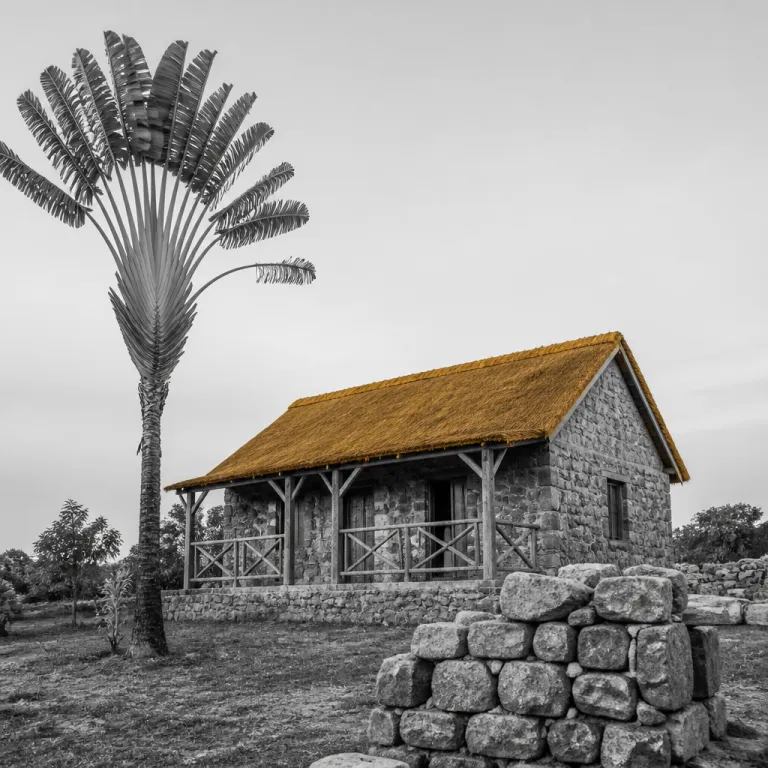
Why madagascar eco lodge architecture design starts with materials, not mood boards
On Madagascar’s coasts and forest edges, every serious lodge begins with a simple constraint: what can actually reach the site. Importing steel and glass across the Indian Ocean is slow, costly and vulnerable, so madagascar eco lodge architecture design leans hard on what the island already offers in abundance. That is why the most compelling lodges and ecolodges feel rooted in the natural environment rather than airlifted from another continent.
In Anjanojano, on the northwest coast of Madagascar, Eden Lodge shows how this constraint becomes an advantage for both architecture and landscape. The entire lodge property is built from Anjanojano stone, fallen tree trunks, coconut wood and ravinala palm leaves, creating a continuous dialogue between structure, beach and forest. When you walk from your single bed under a thatched roof to the shoreline, you read the same materials in the sand, the trees and the low stone walls that define the public spaces.
Across the island, indicative figures shared by the Madagascar National Tourism Office and regional hotel associations in the early 2020s suggest that around 80–85% of lodges use predominantly local materials, and that pattern is visible in every beam and rafter. This is not a decorative eco gesture but a sustainable response to supply chains, climate change and the need to support local communities through construction. For travelers choosing where to stay, understanding this material logic is the first step to reading madagascar eco lodge architecture design as a signal of long term commitment rather than a marketing slogan.
Ravinala palm, thatch geometry and naturally cooled rooms
Ravinala, often called the traveller palm, is the quiet hero of Madagascar’s eco lodge architecture designed for heat, rain and wind. Builders and local artisans have used ravinala palm for centuries, weaving its leaves into steep thatched roofs that shed tropical downpours while trapping cool air inside. When you see those sharply pitched silhouettes from your boat or 4x4, you are looking at vernacular climate engineering, not just picturesque design.
Masoala Forest Lodge on the northeast peninsula takes this principle into the canopy, with treehouses inspired by Betsimisaraka tribal architecture and elevated above the forest floor. Their steep ravinala roofs and open gable ends create cross ventilation that reduces the need for mechanical energy, while the timber frames are cut and assembled by people from nearby local communities using hand tools. The result is an ecolodge where the architecture, the forest landscape and the everyday life of the village are tightly interwoven.
Guests often ask, “What is Ravinala palm?” and the answer from guides is simple and specific: “A native Malagasy plant used in traditional construction.” In practice, that means your room can stay surprisingly cool at midday, your sleep under a single bed mosquito net feels lighter, and your mental health benefits from the soft acoustics of thatch rather than hard concrete. When you evaluate madagascar eco lodge architecture design, look at how ravinala is used in roofs, shading devices and even public spaces like open air lounges.
Local communities and eco tourism operators have revived these traditional methods in recent decades, combining them with modern sustainable building practices documented in training manuals produced by conservation NGOs and technical colleges. Respect local customs, support eco friendly lodges, learn about traditional construction methods. Those three simple guidelines, shared repeatedly by conservation teams on the ground since the early 2010s, capture how architecture, travel and development local priorities can align in one ravinala framed room.
For travelers interested in community owned stays and how architecture supports local life, the in depth guide on village led hospitality in Madagascar offers useful context. It shows how lodge structures, from single bed cabins to larger lodges, can become anchors for local community projects. When you choose an eco lodge that invests in ravinala craftsmanship, you are also investing in skills that keep people employed close to home.
Anjanojano stone, solar energy and the Eden Lodge blueprint
On a remote stretch of sand near Anjanojano, Eden Lodge has become a reference point for madagascar eco lodge architecture design that is both rigorous and indulgent. The property is powered entirely by solar energy, making it one of the first resorts of its kind in Madagascar to run 100% on the sun while still delivering a premium lodge experience, according to lodge sustainability reports and interviews with management teams published in regional travel media. For business leisure travelers used to urban grids, the quiet hum of inverters replacing diesel generators is often the first sign that this is a different kind of resort.
The architecture is anchored in Anjanojano stone, a warm toned local rock that forms low walls, pathways and structural bases. Above these, fallen tree trunks and coconut wood columns carry ravinala thatch, so the transition from stone to leaf mirrors the surrounding landscape architecture of beach, forest and sky. Because the materials are locally sourced, maintenance and future development local projects can draw on the same quarries and forests, reducing transport emissions and reinforcing support local supply chains.
Water management is equally central to the design, with roofs shaped to channel rainwater into storage systems that reduce pressure on the fragile environment. When you walk the site, you notice how every path, terrace and shaded deck is oriented to frame the breathtaking natural views of the Indian Ocean without hardening too much of the shoreline. This is madagascar eco lodge architecture design as a choreography of people, water, energy and nature rather than a static object.
Eden Lodge also illustrates how an eco lodge can influence everyday life in nearby villages through employment, training and procurement. Local community members work as guides, gardeners and maintenance staff, bringing knowledge of tides, wildlife and weather into the operational DNA of the lodge. Over time, that collaboration strengthens local communities and helps them adapt to climate change by valuing intact forests and reefs as economic assets, a trend echoed in case studies compiled by Malagasy tourism researchers and conservation organisations.
When you extend a business trip and want to understand Malagasy flavors as deeply as its architecture, pair a stay at Eden Lodge with the culinary journey outlined in this guide to Madagascar’s food from street stalls to starched linen. The same logic applies in both cases: lodges and restaurants that work with locally sourced ingredients and materials tend to show a more serious long term commitment to place. Reading menus and material palettes side by side becomes an unexpectedly sharp way to judge authenticity.
Forest lodges, organic gardens and the architecture of wellbeing
On the southeast coast, Manafiafy Beach and Rainforest Lodge demonstrates how madagascar eco lodge architecture design can be calibrated for both conservation and guest wellbeing. The property sits between a sheltered bay and dense forest, so its lodges are arranged to preserve sightlines to the water while keeping a generous buffer of natural environment around each structure. That spacing is not only about privacy but also about mental health, giving guests a sense of breathing room that many city hotels cannot match.
Here, timber structures, thatched roofs and stone foundations are paired with an organic garden that supplies much of the kitchen’s produce. Walking from your single bed suite to breakfast, you pass beds of herbs and vegetables that anchor everyday life at the lodge in the soil rather than in imported packaging. For many travelers, this quiet integration of food production, landscape architecture and resort operations feels more luxurious than any marble lobby.
Manafiafy runs on full solar power and, according to lodge reports from the past decade and summaries shared by regional tourism offices, funds local schools, road repairs and forest protection through levies and park fees. That means the architecture designed for guests also underwrites development local projects that benefit surrounding local communities, from safer access to markets to better educational facilities. When you choose a lodge madagascar stay like this, your travel budget becomes part of a wider support local ecosystem rather than a one way extraction.
The forest setting also shapes how public spaces are conceived, with open air lounges, fire pits and viewing decks positioned to frame wildlife corridors and the shimmering Indian Ocean. At night, low energy lighting protects nocturnal species while still allowing guests to move comfortably between lodges and shared areas. This is environmentally friendly design at the scale of a small village, where every path and platform is tuned to both people and nature.
For executives balancing work and rest, these environments can reset mental health in ways that a conventional resort rarely manages. The combination of quiet, green views, organic garden scents and the rhythmic sound of water against the shore creates a sensory palette that slows the nervous system. When you evaluate madagascar eco lodge architecture design, consider not only aesthetics and sustainability but also how the layout supports genuine restoration between meetings and flights.
Tsara komba, Nosy Komba and the island logic of lodge design
Nosy Komba, the volcanic island between Nosy Be and the mainland, offers a different reading of madagascar eco lodge architecture design. Here, steep slopes, black rock and dense forest dictate how lodges like Tsara Komba Lodge step down towards the sea. Instead of broad beachfronts, you find terraces carved into the hillside, where each lodge balances views of the Indian Ocean with shelter from wind and salt spray.
Tsara Komba uses timber, stone and ravinala thatch in a way that feels both refined and resolutely local. The lodges are spaced along the contour lines, so rainwater flows naturally between them into planted swales rather than rushing straight into the sea. This careful choreography of water, soil and vegetation is a quiet masterclass in landscape architecture on a small footprint.
Inside, rooms often feature a mix of single bed and king configurations, catering to both solo business travelers and couples extending a work trip. Furniture is typically crafted by local artisans using locally sourced woods, while textiles reference Malagasy motifs without tipping into pastiche. For guests, the effect is a lodge madagascar experience where design, eco principles and local culture feel seamlessly integrated.
Tsara Komba’s operations also show how lodges can respond to climate change on island sites. By relying on solar energy, careful water management and low impact paths, the property reduces erosion and heat buildup that can threaten both buildings and coral reefs. Guests moving between lodges, restaurant and public spaces experience this as comfort and beauty, but underneath lies a precise environmental strategy.
When you compare Tsara Komba with other lodges on Nosy Be or the mainland, pay attention to how each property uses topography. Some resorts flatten the landscape for convenience, while others, like Tsara Komba, let the natural environment lead the design. For travelers using mymadagascarstay.com to plan an itinerary, this is a key filter: choose lodges whose architecture designed itself around the island rather than forcing the island to adapt.
How to read a lodge’s material palette when booking online
Most travelers will first encounter madagascar eco lodge architecture design through a screen rather than a shoreline. That makes it essential to know what to look for in photos, floor plans and descriptions when you browse a luxury hotel booking website. The goal is to decode whether a lodge’s eco claims are structural or superficial before you commit your time and budget.
Start with materials: do you see ravinala thatch, Anjanojano stone, timber and other locally sourced elements used extensively in both private lodges and public spaces? Properties that rely heavily on imported glass boxes and air conditioning units are less likely to be truly sustainable in the long term. Look for mentions of solar energy, rainwater harvesting, organic garden programs and partnerships with local community projects.
Next, examine how the lodge positions itself in relation to the landscape and natural environment. A serious eco lodge will describe how its architecture designed for minimal footprint, often elevating structures on stilts, clustering lodges to preserve wildlife corridors or restoring degraded land with native planting. Phrases like “breathtaking natural setting” are only meaningful when backed by concrete details about conservation and climate change adaptation.
On mymadagascarstay.com, we evaluate lodges on how well their design supports both guests and local communities. That includes checking whether development local initiatives are funded through levies, whether staff are drawn from nearby villages and whether training programs exist for young people. When a lodge madagascar property aligns architecture, operations and community engagement, it usually delivers a richer travel experience.
As you build an itinerary, consider pairing inland forest lodges with coastal stays, using guides like the refined stays travel guide to Île Sainte Marie for inspiration. This allows you to experience different expressions of madagascar eco lodge architecture design, from ravinala roofed treehouses to stone based beach lodges. Over a single trip, you will see how architecture, eco priorities and everyday life shift from region to region.
Key figures on Madagascar lodge construction and eco design
- Around 80–85% of lodges in Madagascar use local materials such as ravinala palm and Anjanojano stone, according to indicative data shared by the Madagascar National Tourism Office and regional tourism boards in the early 2020s, which significantly reduces transport emissions compared with fully imported construction.
- Traditional methods like hand built timber frames and thatched roofs have been used for centuries in Madagascar, and modern eco lodges now combine these techniques with solar energy systems and improved water management for greater resilience, as highlighted in technical notes from Malagasy architecture schools and conservation NGOs.
- In regions like Anjanojano in northwest Madagascar, the concentration of eco lodges has contributed to increased interest in eco tourism and a documented revival of traditional building techniques among local artisans, as reported by lodge operators and regional tourism offices in annual activity summaries.
- Properties such as Eden Lodge and Manafiafy Beach and Rainforest Lodge operate on full solar power, eliminating the need for diesel generators and cutting operational carbon footprints while maintaining premium service levels, according to their published sustainability statements and third party travel features.
- Partnerships between eco tourism operators and local communities create employment in construction, guiding and maintenance, turning lodge projects into long term development local engines rather than short term building sites, a pattern noted in socio economic impact studies commissioned by Malagasy tourism authorities.
FAQ about Madagascar lodge construction and eco architecture
What is Ravinala palm and why is it used in lodges ?
Ravinala palm, also known as the traveller palm, is a native Malagasy plant whose large, fan shaped leaves are ideal for thatched roofs and wall panels. Builders value it for its availability, insulating properties and ability to shed heavy rain when arranged in steep layers. In eco lodges, ravinala helps keep interiors cool and reduces reliance on mechanical cooling systems.
Where is Anjanojano and why is it important for eco lodges ?
Anjanojano is a coastal area in northwest Madagascar known for its remote beaches and concentration of eco focused lodges. The region’s Anjanojano stone is widely used in lodge construction for foundations, walls and landscape features. This local material palette allows properties like Eden Lodge to integrate visually with the coastline while minimizing transport impacts.
What materials are common in traditional Malagasy lodge construction ?
Traditional Malagasy lodges typically use a combination of ravinala palm leaves for roofing, local timber for structural frames and region specific stones such as Anjanojano stone for foundations and paths. These materials are sourced from the surrounding environment and worked with hand tools by local artisans. Modern eco lodges adopt the same palette, adding improved joinery, better water management and solar energy systems.
How do eco lodges in Madagascar support local communities ?
Eco lodges in Madagascar often hire staff from nearby villages, purchase food and materials from local suppliers and contribute levies or park fees to fund schools, road repairs and conservation projects. Construction phases provide skilled and unskilled jobs, while ongoing operations create long term employment in guiding, hospitality and maintenance. This integrated approach turns architecture projects into platforms for economic and social development.
How can I tell if a lodge’s eco claims are genuine when booking ?
Look for specific information about materials, energy systems and community partnerships rather than generic sustainability language. Genuine eco lodges will mention local materials like ravinala and Anjanojano stone, solar power, rainwater harvesting and concrete projects with local communities. Reviews and specialist platforms such as mymadagascarstay.com can also help verify whether the architecture and operations align with the stated eco values.